

Who We Are
We came to Great Bernera in 2018. We came from Birmingham, where we had spent our working lives in film and media production — Julia as a filmmaker, Nat in production. We came in a van, which we lived in on the croft for longer than we had planned, on land that didn't yet have electricity or running water or any of the infrastructure that makes a piece of land a place to live.
Neither of us had farmed before. Neither of us pretended otherwise. What we had was a clear idea of what we wanted farming to mean: something that took its responsibilities seriously, to the land and the animals and the community, rather than treating a croft as a backdrop for a different kind of life.
The van years were harder than we expected and more formative than we knew at the time. Living that close to the land — dependent on it for water from the burn, light from a generator, warmth from what you could cut or gather — changes your relationship to it in ways that are difficult to articulate and easy to lose once the house is built and the electricity is connected. We have tried to hold onto the understanding that those years gave us.
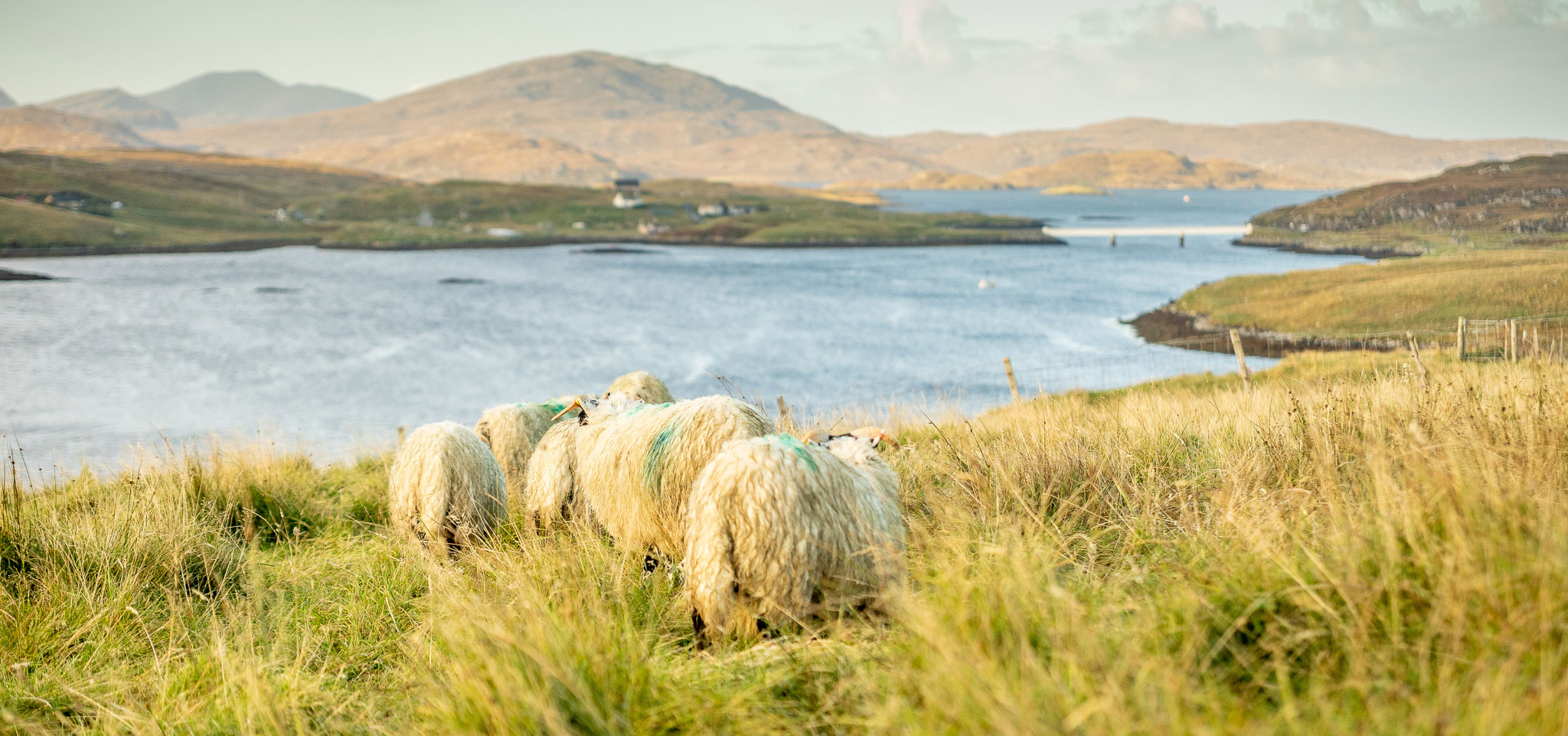
Seven years in, the house is built. The electricity is connected. The croft has a polytunnel and a growing kitchen garden and a flock of black sheep and more than a thousand trees that weren't there before. It is recognisably what it was always trying to become.
We are still learning. The Hebrides is still teaching us. The gap between what we knew when we arrived and what we know now is large. The gap between what we know now and what we still need to learn is larger.
Why Here
Great Bernera was not the only island we considered. It was the one we kept coming back to.
The island is small enough to know in its entirety — you can walk its length in a morning — but substantial enough to have its own distinct character. It has a community that has been here for generations, that fought in 1874 to stay on this land when the estate tried to take the grazing from them, and that has continued to hold on through everything the twentieth century offered by way of incentives to leave.
The land of Croft 22 sits on the east side of the island, looking out over East Loch Roag. Behind it: the open moorland that covers most of the interior. In front: the water, the other islands, the Lewis mainland across the loch. In every direction, eventually, the sky.
What drew us to Great Bernera specifically was partly the land — the quality of the soil in the old croft ground, the shelter provided by the stone walls, the access to the shore. Partly the community — the sense of people who understood what it meant to work land that had been worked before. And partly something harder to name: the feeling that this particular piece of ground, in this particular place, was asking to be looked after.
That might sound fanciful. It did not feel fanciful when we arrived. It does not feel fanciful now.
The bridge
You reach Great Bernera by a single-track road across a bridge at Breasclete. The bridge — the first pre-stressed concrete bridge in Europe, built in 1953 — is there because the islanders of Bernera demanded it, and when the county council delayed year after year, they threatened to build it themselves. The council eventually built it rather than be embarrassed by being beaten to it by crofters with their own materials.
This is the first thing you learn about Great Bernera: that it is a place where people, when they need something, find a way to get it done.
The light
The light on Great Bernera is unlike anything on the mainland. In summer, it lasts until eleven at night and begins again before four in the morning. In winter it retreats to a few hours of low, golden, almost horizontal illumination that makes everything it touches look like it is being lit for a painting. In between, it is variable in a way that means the same piece of ground looks like a different place in the morning and the afternoon and after the rain.
You don't get used to it. You become more alert to it.
What We Believe
Degrowth is a word that requires unpacking wherever it appears. It sounds like a call to go without, to reduce, to make do with less as an act of virtue. That is not what it means to us, and it is not what it looks like in practice on this croft.
What degrowth means here is something closer to accuracy. The growth economy is built on the assumption that more is always better — more production, more consumption, more GDP, indefinitely, on a finite planet. That assumption is wrong, and the consequences of its wrongness are visible in the climate, in the soil, in the water, in the health of ecosystems everywhere that growth has been pursued without limit.
Degrowth is the argument that an economy organised around sufficiency rather than growth is not a poorer economy but a more honest one. That “enough” is a meaningful concept and that building a life around it is both harder and more interesting than the alternative.
This croft is an attempt to find out what that looks like, on 18 acres, in the Atlantic, over time.
In practice, it looks like this: we do not buy inputs we can source or make ourselves. We do not scale up because scaling up is available to us. We do not borrow against the future productivity of the land to pay for things now. We make decisions that the land can sustain and we try not to make ones it can't.
This is not always the economically rational choice in the short term. It is our best attempt at the rational choice in the long term. The land will be here after us. We are trying to leave it better than we found it, not merely not worse.
Doughnut Economics
Kate Raworth's Doughnut Economics framework gives useful shape to some of these instincts. The doughnut describes an economy that operates between two boundaries: an inner ring of social foundations — the things every person needs and deserves — and an outer ring of planetary limits that cannot be safely exceeded. The space between is where human flourishing is possible without destroying the conditions that make it possible.
We helped run the first Lewis Doughnut cohort in 2021 — a group of people working through the framework together, trying to understand what Doughnut thinking looks like when the island is Lewis, when the economy is built around fishing and tourism and public employment, when the land question has the particular history it has here.
Those conversations changed how we think about what the croft is for. It is not just a farm. It is a working model of what an economy looks like when it takes sufficiency seriously. It is an attempt to demonstrate, in a specific place, that another way of doing things is not only possible but already happening.
We are not the answer to anything. We are one data point. But data points accumulate.