
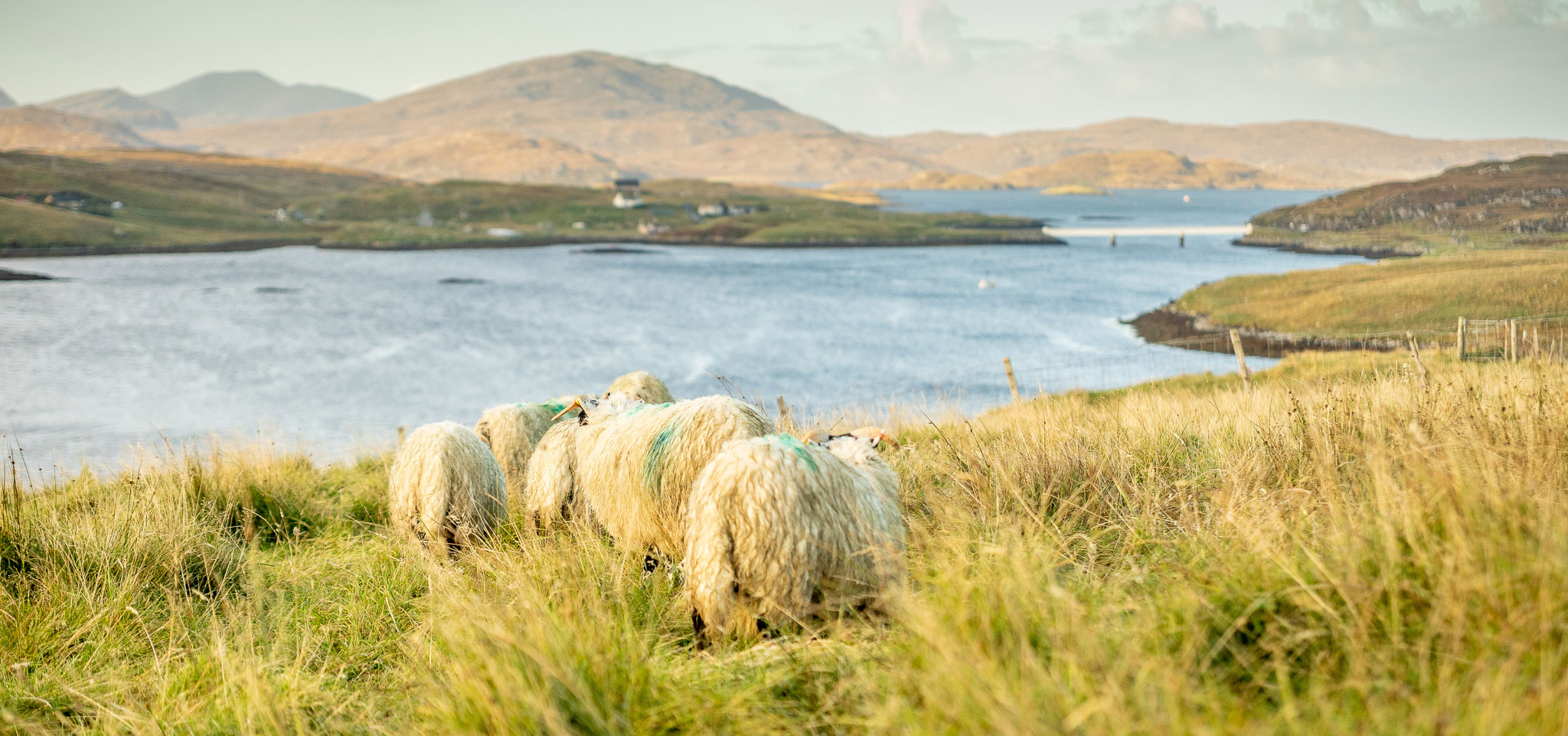
Flock
The ancient flock of Great Bernera.
Two-horned Hebridean sheep, Viking origins, and the rugs they become.
Hebridean sheep are not like other sheep. They are small, dark, and self-possessed in a way that most modern breeds have had bred out of them. Their fleece is black — not grey, not brown, but genuinely, deeply black — and their horns, on the two-horned variety we keep at CRØFT 22, curve away from the head with the kind of deliberate geometry that makes you stop and look.
They arrived in the Hebrides with Viking settlers around 850 AD. They have barely changed since. The islands suited them then, and still suit them: the salt-laden Atlantic air, the rough grazing, the weather that comes in sideways for days at a time. Where other breeds pace about and look miserable in the Hebridean winter, Hebridean sheep simply get on with it. They have had over a thousand years of practice.
The two-horned variety is the rarer form. Most people who encounter Hebridean sheep for the first time meet the four-horned variety — which is remarkable enough. The two-horned animal is quieter in its strangeness but no less striking. Both horns in frame, lit by Atlantic light: it is one of the most distinctive animals in British farming and almost entirely unknown outside it.
Our Flock
Our sheep live on the croft year-round. They graze the open ground, the rough edges, the places where the vegetation is too tough and salt-matted for the kitchen garden but perfectly suited to a breed that has spent eleven centuries eating whatever the Hebrides offers.
They are not pets, but they are known. Each animal has its own character — the ones who come to the gate and the ones who stay back, the ones who are first to the hay and the ones who wait. Working with the same small flock over years means you notice things: which animals are thriving, which need watching, how the flock as a whole is doing in relation to the season and the grazing.
The flock is also doing work that doesn't show up in any product. Their grazing keeps the rough ground open and varied. Their dung returns fertility to the soil. Their feet — small and precise, not the heavy hooves of larger breeds — disturb the ground just enough to encourage the kind of plant diversity that heavy-footed commercial breeds suppress. They are part of the land system, not just occupants of it.
Shearing
Shearing happens in early summer, when the fleece has grown to its fullest and before the warmest weather arrives. On a small flock like ours, shearing is a focused few days of work rather than a season-long operation — it requires skill and the right equipment, and it is one of the times of year when the animals and the people are in closest contact.
The Hebridean fleece that comes off is dense and lanolin-rich, the colour of dark water. It is not soft in the way that Merino is soft — it is a double-coated hill breed fleece, coarser and more durable. That coarseness is exactly what makes it useful for rugs and hard-wearing textile work. It will not felt easily. It will last.
After shearing, the best skins — selected for size, condition and the quality of the fleece — go to the Welsh Organic Tannery in Wales. The rest of the fleece is sold raw or lightly prepared through the Forage shop and directly to spinners and textile makers.
From Fleece to Rug: The Tanning Process
Most commercial sheepskin is chrome-tanned. Chromium sulphate is cheap, fast, and produces a consistent result. It also produces significant chemical waste and a skin that, over time, becomes brittle and degrades in ways that vegetable-tanned skin does not.
The Welsh Organic Tannery uses traditional vegetable-tanning processes — natural tannins derived from tree bark, principally oak, worked slowly into the skin over weeks rather than hours. The process is older than industrial chemistry. It produces a skin that is softer, more breathable, and more durable than chrome-tanned alternatives. It does not involve heavy metals.
The rugs that come back from Wales are the colour they are: the deep, warm black-brown of a Hebridean fleece in winter light. They are not dyed. They are not treated beyond the tanning process. They are, as much as a processed product can be, exactly what they started as.
The Rugs
Each rug is unique. The size depends on the animal. The character — the density of the fleece, the particular depth of colour, the way the wool falls — depends on the individual sheep, the year, the season.
We can tell you what year a rug came from. We can tell you from which shearing. For named animals, we can tell you more than that.
The rugs are sold directly from the croft. There is no retailer between us. The price reflects the true cost of producing them: the care of the flock, the quality of the tanning, the small batch scale of everything we do.
Six things no other rug can say
- Named croft, named island: Great Bernera, Isle of Lewis
- Rare native two-horned Hebridean breed (RBST listed)
- Documented degrowth and regenerative philosophy
- Welsh Organic Tannery: certified organic, vegetable tannins, no chrome or bleach
- Genuinely individual: natural colour variation, no two the same
- Zero waste: by-product of animals that lived full lives on the croft
How to look after a vegetable-tanned sheepskin rug
Shake regularly. Air outdoors occasionally. If it gets wet, dry slowly away from direct heat — the skin needs to dry at its own pace or it will stiffen. If it gets dirty, spot-clean with cold water and a small amount of wool wash. Do not put it in a washing machine. Do not put it near a radiator. Treat it like the natural object it is and it will last decades.
Stock, sizes, and pricing coming soon. Get in touch if you'd like to be notified when rugs are available.